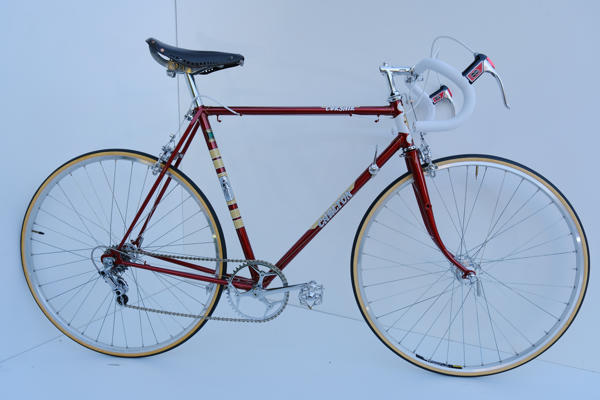
Corsair
Brand
CarltonDescription
Carlton Corsair — The Accessible Clubman's Lightweight
The Carlton Corsair, produced during the 1960s and early 1970s at the Worksop factory, occupied the mid-range of Carlton's model hierarchy — a clubman's lightweight positioned below the Professional, International, and Flyer, but above the entry-level Cobra and Criterium. It was the bicycle for the club rider who wanted a genuine hand-built Carlton from the Worksop shop but did not require — or could not stretch to — the full racing specification of the top-tier models.
Frame Construction
The Corsair employed Reynolds 531 plain-gauge main tubes (top, down, and seat) with heavier-gauge stays and fork blades. This economisation on the full butted 531 specification of the International and Professional kept the Corsair at an accessible price while retaining the fundamental ride quality of Reynolds manganese-molybdenum steel. The frame was hand-brazed throughout at Worksop, with brass filler and the same jig-free freehand methods used on Carlton's professional-grade machines.
Lugs were typically Nervex or Prugnat investment-cast patterns, clean in profile but without the hand-filed decorative carving of the Professional. The distinctive Carlton-pattern fork crown — shared across the model range — provided a visual link to the more expensive siblings. Dropouts were generally Huret or Gipiemme vertical rather than the Campagnolo found on top-tier models, with mudguard eyes fitted to most examples.
Geometry
The Corsair followed the British clubman's geometry common to the Carlton range: approximately 72–73 degree angles parallel, generous fork rake in the 45–50 mm range, and a wheelbase that favoured stability over twitchy racing responses. The result was predictable, confidence-inspiring handling suited to the mixed demands of club runs, light touring, and the occasional evening time trial.
Finishing
Carlton Corsairs typically left Worksop in restrained colour schemes — deep blues, bronze-greens, burgundy, or the occasional metallic gold — with the Carlton script wordmark on the down tube, the "Corsair" model designation on the top tube, and the Reynolds 531 transfer on the seat tube. Chrome was generally confined to fork tips and rear dropout faces. The overall aesthetic was handsome and workmanlike: a bicycle that promised quality without ostentation.
Component Specification
A representative Corsair would feature components reflecting its mid-range positioning: GB or unnamed alloy bars and stem, a Brooks or Lycett saddle, a Stronglight or Williams steel-chained crankset, Huret or Simplex derailleurs, GB or Weinmann side-pull brakes, and Normandy or steel-barrelled hubs laced to Rigida or Weinmann alloy rims. Bluemels mudguards were a common fitment for the practical club rider.
Why a Restored Corsair Appeals
The Corsair offers the most accessible entry point into Worksop-built Carlton ownership. It delivers the essential Carlton experience — Reynolds 531 tubing, hand-brazed construction, the Carlton fork crown, and the unmistakable Worksop decal set — at a price point well below the Professional or International. British-standard threading ensures compatibility with a wide range of components. A restored Corsair, sympathetically built with period equipment, is an honest, rideable, and historically genuine British lightweight — the clubman's bicycle in its most attainable form.
Tags: Carlton Corsair, Carlton Cycles, Reynolds 531, Worksop framebuilder, British lightweight, Nervex lugs, Prugnat lugs, 1960s clubman bicycle, hand-brazed frame, Carlton fork crown, vintage Carlton, restored Carlton, classic British road bike, clubman lightweight