Sprint
Brand
ColnagoDescription
Colnago Sprint — The Entry Ticket to Cambiago
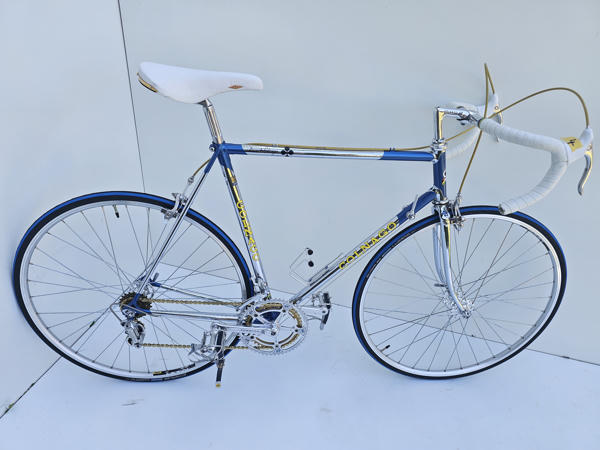
The Colnago Sprint, produced from the late 1970s through the mid-1980s, occupied the accessible entry point of Ernesto Colnago's model hierarchy — a genuine Cambiago-built frame that brought the marque's racing DNA and Italian craftsmanship within reach of the club rider and aspiring racer. Positioned below the Super, the Mexico, and the Master, the Sprint was Colnago's answer to the rider who wanted the ace-of-clubs on their head tube without the premium commanded by the professional-grade machines. It was not a budget bicycle — Colnago did not build budget bicycles — but it was the simplest, most attainable Colnago, and for a generation of Italian cyclists it was the first step into serious cycling.
Model Positioning
The Sprint filled a deliberate and commercially important role: it extended the Colnago brand downward into the sportive and club-racing market without compromising the workshop's fundamental build standards. Where the Super was specified for serious amateur racing and the Mexico for record-breaking rigidity, the Sprint was built for the spirited club run, the local criterium, and the rider developing their legs. It was the Colnago you bought when you were on the way up — and it carried the same Cambiago head badge as the machines that won Paris–Roubaix.
Frame Construction
The Sprint employed Columbus Aelle straight-gauge chromoly tubing on most examples, with some later or higher-specification frames using Columbus Cromor — both competent, durable tubesets positioned below the butted SL and SLX that defined the Super and Superissimo. The frame was hand-brazed throughout with brass at the Cambiago workshop, with clean shorelines and the geometric precision that distinguished Colnago production from anonymous subcontract work.
Lugs were typically investment-cast patterns — generally the same Agrati or Bocama designs used across the Italian industry — neatly finished but without the hand-carving or decorative profiling of the Super or Master. The fork employed a Colnago-pattern crown, slightly simpler in profile than the top-tier models but unmistakably from the same workshop. Dropouts were typically Campagnolo 1010 or, on later examples, Gipiemme vertical, with chromed faces. The bottom bracket shell was Italian-threaded throughout, maintaining full Campagnolo compatibility. A notable feature on many Sprints was the chromed fork and rear stays — a visual link to the more expensive models that elevated the frame beyond its price point.
Geometry
The Sprint employed sportive road geometry — slightly more relaxed than the aggressive Super or Master, reflecting its intended use for club riding and developing racers:
- Seat tube angle: 73 degrees — efficient but not extreme
- Head tube angle: 72–73 degrees — stable and predictable
- Fork rake: 45–48 mm — balanced handling
- Chainstay length: 410–415 mm — responsive without being twitchy
- Bottom bracket drop: Approximately 68–70 mm
The ride quality offered the communicative, engaging feel of an Italian steel frame without the demanding sharpness of a full-race geometry — a forgiving and enjoyable ride that rewarded effort without punishing inattention.
Paint and Finishing
Sprint frames received Colnago's characteristic paint finishing, though typically in simpler schemes than the elaborate Art Decor treatments of the Master. Common colours included Colnago red, deep blue, white, and occasionally black, with the iconic Colnago script decals on the down tube, the "Sprint" model designation on the top tube, and the Columbus tubing transfer on the seat tube. Chrome plating on the fork blades and rear stays — a prized feature — provided the classic Colnago chrome-and-colour contrast. The overall aesthetic was clean, purposeful, and unmistakably Colnago.
Component Specification
A representative Sprint would be built with components reflecting its accessible positioning: Campagnolo Nuovo Record, Gran Sport, or Victory groupset depending on era and original specification, though many Sprints were also built with Ofmega or Gipiemme Italian components. Cinelli or 3TTT bars and stem, a Selle Italia Turbo or Selle San Marco Rolls saddle, and Campagnolo or Miche hubs on Ambrosio or Mavic rims would complete a period-correct build.
Why a Restored Sprint Appeals
The Colnago Sprint offers the most accessible entry into genuine Cambiago ownership. It delivers the essential Colnago experience — the head badge, the script decals, the Italian geometry, the hand-brazed construction — without the premium commanded by a Super, Mexico, or Master. Italian-standard threading ensures straightforward Campagnolo compatibility. The chromed stays and fork, present on many examples, provide the classic Colnago visual signature. For the collector who wants to own and ride a genuine Colnago without the investment-level price tag of the top-tier models, the Sprint is the logical and deeply satisfying choice — the Cambiago workshop's open door.
Tags: Colnago Sprint, Columbus Aelle, Columbus Cromor, Cambiago, Ernesto Colnago, Italian road bicycle, Campagnolo 1010, Italian standard threading, chrome stays, Colnago script decal, entry-level Colnago, hand-brazed frame, 1980s Italian bicycle, vintage Colnago, restored Colnago, Campagnolo Nuovo Record, Colnago club rider