Magnum Bonum
Brand
HetchinsDescription
Hetchins Magnum Bonum — The Great Good, Tottenham's Definitive Curly-Stay Masterpiece
The Hetchins Magnum Bonum — Latin for "Great Good" — represents one of the most coveted and elaborately appointed models to emerge from the Tottenham workshop under master framebuilder Jack Denny. Produced during the marque's golden period from the late 1940s through the 1960s, the Magnum Bonum sat at or near the summit of Hetchins' Latinate model hierarchy, rivalled only by the Magnum Opus and the pure-racing Nulli Secundus. Where the Opus was explicitly positioned as the all-round sportive machine and the Secundus the uncompromising racer, the Magnum Bonum represented Hetchins' philosophy in its most complete and generously specified expression — a bicycle on which no element of construction, decoration, or finishing was economised.
Name and Positioning
The naming of Hetchins models followed a deliberate Latin convention, each designation communicating the frame's intended character. Magnum Bonum — the Great Good — implied a frame that excelled across every dimension: build quality, ride characteristics, decorative artistry, and overall refinement. It was not a specialist but a synthesis of Hetchins' capabilities, and it was priced and specified accordingly. A Magnum Bonum was the bicycle ordered by the clubman of means who wanted the best Hetchins could produce — not a bike for a single purpose, but a bike for every purpose, built without compromise.
Frame Construction and Materials
The Magnum Bonum was constructed from Reynolds 531 butted manganese-molybdenum steel tubing throughout — full 531 main tubes, stays, and fork blades, with no economisation to plain-gauge or seamed alternatives. This represented the finest tubeset available to British framebuilders in the post-war decades, and Hetchins employed it in its lightest and most responsive gauge combinations appropriate to the customer's weight and riding requirements.
The frame was entirely hand-brazed, employing the jig-free freehand method for which the Denny workshop was renowned. The builder aligned each joint by eye and touch, tacked the assembly, checked alignment on a surface table, and completed the brazing with brass filler — a painstaking process that demanded decades of accumulated skill and yielded a frame whose alignment accuracy often exceeded that of jig-built production frames. The result is visible in the clean, even shorelines at every lug junction and the precise fit of every tube into its mating socket.
The Curly Stays
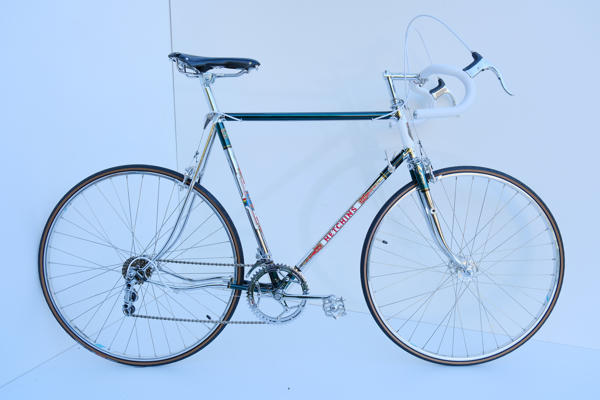
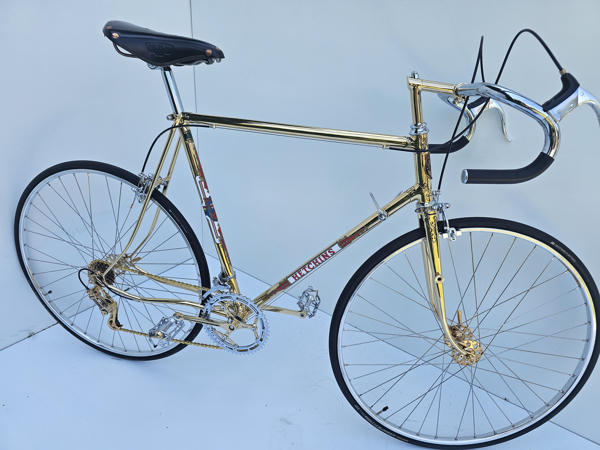
The Magnum Bonum featured the curly "vibrant" stays in their most accomplished form. The seat stays swept forward from the Campagnolo rear dropouts in a pronounced S-curve or, on some examples, a full 360-degree spiral before tapering into the fastback seat cluster. These were formed from solid round-section steel rod, bent cold on a purpose-made jig, with the diameter carefully selected to maintain structural safety while permitting the visual drama of the curve. The chain stays received the restrained single-wave treatment, with a pressed dimple on the right-hand stay for chainring clearance. On the Magnum Bonum, the curly stays were executed with particular refinement — the curves symmetrical, the transitions smooth, the polishing to a mirror finish on chromed examples — reflecting the model's position at the apex of Hetchins production.
Lug Work and Decorative Detailing
The Magnum Bonum received the most elaborate lug carving of any standard-production Hetchins model. The head lugs were filed into extended arrowhead or spear-point profiles, with multiple cut-outs, deeply bevelled edges, and polished highlights that caught the light from every angle. The fastback seat cluster was sculptural — the stays brazed directly into a purpose-shaped seat lug, the junction filed to an organic, flowing form that seemed to grow from the frame rather than being assembled. The bottom bracket shell, typically Chater-Lea or Haden pattern, was fully pierced and scalloped with decorative cut-outs, the edges chamfered and polished. The fork crown — the distinctive Hetchins-pattern investment-cast design — was similarly hand-filed to accentuate its sculpted profile.
Every lug on a Magnum Bonum exhibits the evidence of the filer's hand: the tool marks have been polished away, but the asymmetry and individuality of hand work remain, making each frame subtly unique. This was not ornament applied to a production frame; it was the frame itself, conceived as a decorative object from the outset.
Geometry
The Magnum Bonum employed sportive road geometry — responsive enough for brisk club riding and the occasional road race, comfortable enough for all-day distance:
- Seat tube angle: 72–73 degrees — a sustainable position for long hours without sacrificing pedalling efficiency
- Head tube angle: 72–73 degrees — quick but not nervous, stable on fast descents
- Fork rake: 45–50 mm — balancing responsive steering with straight-line composure
- Chainstay length: 410–420 mm — a versatile mid-point between racing agility and touring stability
- Bottom bracket drop: Approximately 68–72 mm
- Wheelbase: Approximately 1000–1030 mm
This geometry produced a ride quality that was quintessentially Hetchins: the vertical compliance of the curly stays absorbing road buzz, the Reynolds 531 tubeset delivering a lively, communicative feel, and the overall balance inspiring confidence across the full range of road conditions from smooth tarmac to rough B-road chip-seal.
Paint, Chrome, and Finishing
The Magnum Bonum represented Hetchins' finishing at its most elaborate. The standard specification included fully chromed fork blades and rear stays — the mirror-bright chrome contrasting with the frame's enamel main tubes and highlighting the curly stay contours. The head tube, seat cluster, and bottom bracket shell often received chrome underlays with translucent tinted top coats, producing a depth of colour unattainable by solid paint alone. Lug lining — the hand-applied gold or white pinstripe tracing the edges of the carved lugs — was executed with a fine brush by the workshop's painter.
Paint colours tended toward the rich and sophisticated: deep royal blues, burgundy, British racing green, and occasionally a remarkable deep violet or claret, all finished in high-gloss baked enamel over an anti-corrosion primer. The Hetchins script decals — the marque name in flowing gold or white on the down tube, the model designation on the top tube, and the Reynolds 531 transfer on the seat tube — were applied beneath a final clear lacquer coat, protecting them from abrasion and UV fading.
Period-Correct Specification
A Magnum Bonum would have been built to the customer's individual specification, but a representative period-correct build would include: Cinelli or GB alloy handlebars and stem, Brooks B17 or B15 leather saddle, Stronglight 49D or TA crankset with appropriate gearing, Simplex or early Campagnolo Gran Sport derailleurs, GB or Mafac centre-pull brakes, Campagnolo or Maillard high-flange hubs laced to Rigida, Weinmann, or Mavic alloy rims, and Bluemels mudguards for year-round club riding. The customer might specify a Carradice saddlebag for the full British clubman's aesthetic.
Rarity and Collectability
The Magnum Bonum is among the rarest and most desirable Hetchins models. Fewer were built than the Magnum Opus or Experto Crede, and fewer still survive with their original curly stays intact, their decorative lug carving undamaged, and their period paint and decals preserved. A Denny-era Magnum Bonum in original or sympathetically restored condition represents a blue-chip acquisition — the fullest expression of Hetchins' marriage of structural ingenuity and decorative artistry, executed at the historic peak of British hand-built framebuilding.
Tags: Hetchins Magnum Bonum, curly stay frame, Reynolds 531, Jack Denny, hand-carved lugs, fastback seat cluster, Chater-Lea shell, British lightweight, Tottenham framebuilder, chromovelato finish, vintage steel bicycle, restored Hetchins
-119-preview-thumbnail_eef8ed94.jpg)