Experto Crede
Brand
HetchinsDescription
Hetchins Experto Crede — The Post-War Clubman's Lightweight
The Hetchins Experto Crede — Latin for "Trust the Expert" — was the marque's definitive mid-range clubman's lightweight, introduced in the immediate post-war period and produced through the 1950s into the 1960s at the Tottenham workshop under Jack Denny. Positioned below the racing Nulli Secundus and the all-round Magnum Opus but above the basic touring models, the Experto Crede offered the amateur club rider a genuine hand-built Hetchins with the marque's signature curly stays and decorative lugwork at an accessible price point. It was, in essence, the entry ticket to Hetchins ownership — a machine built without the full racing specification of the top-tier models but with every essential element of the Tottenham workshop's artistry intact.
Model Positioning and Philosophy
The Experto Crede occupied a vital role in Hetchins' model hierarchy. Where the Nulli Secundus was specified for elite competition and the Magnum Opus for the demanding sportive rider, the Experto Crede was aimed squarely at the British cycling club member — the rider who participated in Sunday club runs, evening time trials, and the occasional road race, but whose primary requirement was a versatile, comfortable, and beautifully constructed machine for year-round use on Britain's varied road surfaces. The name itself was a confident statement: the experienced cyclist, Hetchins implied, would recognise the quality of the frame without needing the top-tier specification.
Crucially, the Experto Crede was a fully hand-built Hetchins — not a subcontracted frame, not a budget line. It was brazed in the same jigs, by the same hands, and to the same fundamental standards as every other frame bearing the Hetchins name.
Frame Construction and the Curly Stays
The Experto Crede was constructed from Reynolds 531 butted manganese-molybdenum steel tubing — in most examples, Reynolds 531 main tubes (top, down, and seat) with plain-gauge 531 or heavier-gauge stays. This represented a modest economisation over the full-butted 531 throughout of the Nulli Secundus, but the difference in ride quality was subtle rather than stark.
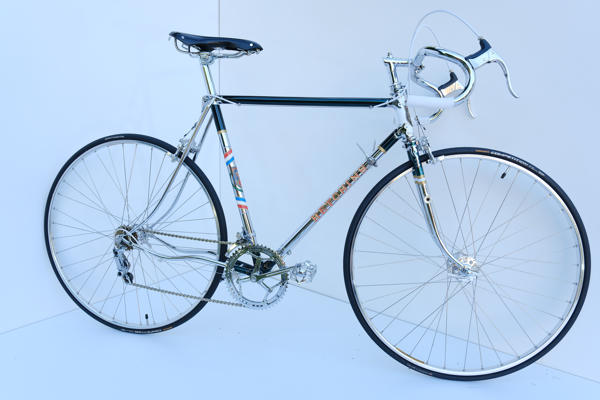
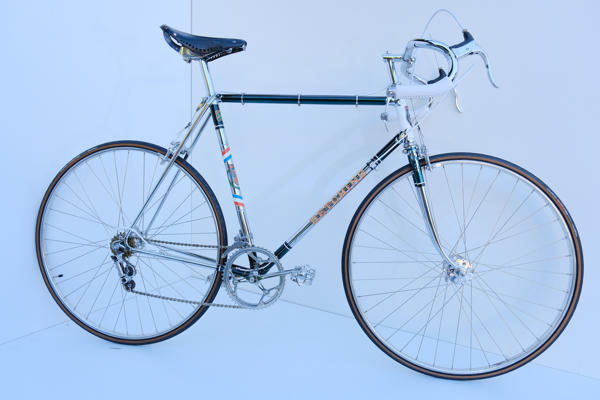
The defining curly "vibrant" stays were present in full — the seat stays sweeping through their characteristic S-curve or spiral before meeting the rear dropouts, and the chain stays featuring the restrained single-wave treatment. On the Experto Crede, the curly stays demonstrated that the feature was not reserved exclusively for the most expensive models: even the accessible Hetchins carried the marque's unmistakable visual signature.
The frame featured Nervex-pattern or Hetchins-adapted lugs with hand-filed decorative cut-outs — the elongated arrowhead or spear-point motifs that marked the Denny workshop's output, though typically with slightly less elaborate carving than on the Magnum Opus or Nulli Secundus. The fastback seat cluster and sculpted bottom bracket shell — often Chater-Lea, Haden, or Brampton pattern — were standard. Dropouts were typically Campagnolo or Hetchins-pattern vertical, with mudguard eyes fitted to most examples to accommodate the year-round British clubman's practical requirements.
Geometry and Ride Characteristics
The Experto Crede employed geometry that balanced sportive responsiveness with all-day comfort — a reflection of its British club-riding purpose:
- Seat tube angle: 72–73 degrees — slightly more relaxed than pure racing geometry, allowing a sustainable position for long club runs
- Head tube angle: 72–73 degrees — stable without being sluggish
- Fork rake: 45–50 mm — a middle ground between touring stability and racing quickness
- Chainstay length: 410–420 mm — shorter than the Vade Mecum touring model, longer than the Nulli Secundus racer
- Bottom bracket drop: Approximately 68–72 mm
The result was a bicycle that handled with the predictable, confidence-inspiring character for which British lightweight frames were prized — quick enough for the evening ten-mile time trial, comfortable enough for the hundred-mile reliability ride.
Lug Work and Finishing
The Experto Crede exhibited the hand-carved lug profiles that defined Hetchins quality. While the level of decorative carving was typically less extravagant than on the top-tier models, the head lugs, seat cluster, and bottom bracket shell all received the attention of the filer's hand. No two frames were identical. Paintwork tended toward the restrained: deep blues, dark greens, burgundy, or black with contrasting lug lining in gold or white, the Hetchins script transfer on the down tube, and the "Experto Crede" model designation on the top tube. The overall aesthetic was one of understated quality — a bicycle that revealed its craftsmanship on close inspection rather than shouting from across the road.
Component Specification
The Experto Crede was typically built with components reflecting its clubman's positioning — reliable, serviceable, and of proven quality rather than exotic racing specification: GB or Cinelli alloy bars and stem, Brooks B17 or B15 saddle, Stronglight 49D or Williams crankset, Simplex or Huret derailleurs, GB or Mafac centre-pull brakes, Normandy or Maillard hubs on Rigida or Weinmann alloy rims, and Bluemels mudguards for the obligatory British club-run weather protection.
Rarity and Collectability
The Experto Crede, occupying the mid-range of Hetchins production, was built in greater numbers than the Magnum Opus or Nulli Secundus — but this does not make it common. Total Hetchins production across all models numbered in the low thousands, and surviving Experto Credes remain genuinely scarce. The model's particular appeal lies in its accessibility: it offers the essential Hetchins experience — curly stays, hand-carved lugs, Reynolds 531 construction, Tottenham provenance — without the premium commanded by the top-tier models. For the collector seeking a rideable, practical Hetchins with all the marque's visual and mechanical hallmarks, the Experto Crede is the most attainable and arguably the most sensible entry point.
Tags: Hetchins Experto Crede, Hetchins clubman bicycle, curly stay road bike, Reynolds 531 lightweight, Jack Denny framebuilder, Hetchins vibrant stays, British lightweight road bicycle, vintage clubman bicycle, Chater-Lea bottom bracket, Hetchins fastback seat cluster, hand-carved Arrowhead lugs, Tottenham framebuilder, 1950s British road bike, restored Hetchins, classic British lightweight, Brooks B17, Stronglight 49D, Mafac centre-pull brakes, Bluemels mudguards, Nervex pattern lugs, Hetchins curly chainstays, mid-century steel frame, bespoke English framebuilding