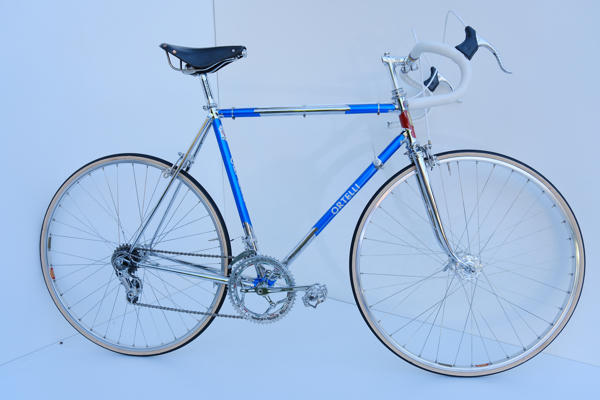
Faenza
Brand
OrtelliDescription
Ortelli Faenza — The Artisan's City-Named Frame
The Ortelli Faenza is one of the most elusive models to emerge from the small Milan–Lombardy workshop of the Ortelli family, active from approximately the 1920s through the 1960s. The model name itself is revealing: Faenza, a city in neighbouring Emilia-Romagna renowned since the Renaissance for its hand-painted ceramics and fine decorative arts, suggests that this particular Ortelli frame occupied a position of particular refinement within the workshop's limited output. While documentation of Ortelli's model designations is fragmentary at best — the workshop kept no catalogues, published no brochures, and maintained no advertising — surviving examples bearing the Faenza identification point to a sportive road frame of elevated specification, likely produced during the workshop's 1950s to early 1960s peak.
Model Positioning
Within the Ortelli workshop's tiny output, the Faenza designation appears to have signified a decoratively finished sportive lightweight — a frame that combined the workshop's standard racing geometry with more elaborate paint and detailing than the straightforward, unadorned road frames that constituted Ortelli's bread-and-butter production. The Faenza name, evoking Italy's most celebrated centre of ceramic artistry, implied a frame where visual presentation received particular attention: finer paint finishes, more careful lug lining, perhaps a hand-detailed head badge or decorative treatment of the fork crown. It was the Ortelli for the customer who wanted his bespoke frame to look as refined as it rode.
Frame Construction
The Faenza frame employed Columbus SL butted chromoly steel tubing — the standard premium Italian tubeset of the post-war period — brazed with brass throughout, with the clean shorelines that distinguished the Ortelli workshop's hand-building from mass production. Lug sets were investment-cast Agrati or Bocama patterns, selected for their clean profiles and hand-finished with subtle filing. The fork employed the Ortelli-pattern crown — a modestly sculpted design consistent with the Lombard school — with chromed fork tips and a chromed steerer. Dropouts were Campagnolo 1010 vertical with an integral derailleur hanger, the universal quality standard of the era. The frame was built for Italian-standard threading throughout, ensuring compatibility with the Campagnolo componentry that a frame of this specification would have carried.
Geometry
The Faenza adhered to the classic Italian road-racing formula that defined the Ortelli workshop's output: 73–74 degree seat tube angle, 72–73 degree head tube, short chainstays, and a bottom bracket drop of approximately 68–72 mm. These proportions delivered the quick, responsive handling and forward-weighted riding position characteristic of Italian competition bicycles — a geometry as suited to the spirited club ride as to the occasional road race.
Finishing
The Faenza's distinguishing characteristic — the element that set it apart from Ortelli's standard models — was its finish quality. Where a typical Ortelli frame might leave the workshop in a straightforward single-colour enamel, the Faenza received enhanced treatment: two-tone paint schemes with contrasting seat-tube panels, hand-applied lug lining in gold or white tracing the edges of the investment-cast lugs, and a carefully applied Ortelli head badge — often more elaborate than the standard transfer, possibly a multi-colour enamel plaque referencing the decorative tradition of Faenza itself. The paint was baked enamel over an anti-corrosion primer, finished with a clear top coat to protect the decals and lining.
Rarity and Authentication
The Ortelli Faenza is among the rarest identifiable models in vintage Italian cycling. As with all Ortelli frames, authentication relies on the presence of the Ortelli head badge, the model designation (if the original decals survive), and construction details consistent with the Lombard workshop's hand. No serial number records exist. Every surviving Faenza represents a tangible link to a workshop and a tradition that operated almost entirely outside the written record — known only through the bicycles that occasionally surface in Italian and European collections.
Why a Restored Faenza Appeals
The Ortelli Faenza speaks to the collector who values rarity, regional authenticity, and the Italian artisan tradition above brand recognition. This is not a bicycle that announces itself from across a showroom — it is a bicycle that reveals its quality slowly, through the refinement of its brazing, the balance of its geometry, and the restrained elegance of its paint. Built with a period Campagnolo Gran Sport or Nuovo Record groupset, Cinelli bars and stem, and a Brooks or Selle Italia saddle, a restored Faenza becomes a rideable expression of the Lombard framebuilder's art — a machine as individual as the customer who commissioned it and the craftsman who built it.
Tags: Ortelli Faenza, Ortelli model, Columbus SL tubing, Italian artisan framebuilder, Lombardy bespoke bicycle, hand-brazed frame, Campagnolo 1010 dropouts, Italian standard threading, Agrati lugs, Bocama lugs, 1950s Italian road bicycle, two-tone paint finish, hand-applied lug lining, vintage Italian steel, rare Ortelli, Campagnolo Gran Sport, Campagnolo Nuovo Record