Vade Mecum
Brand
HetchinsDescription
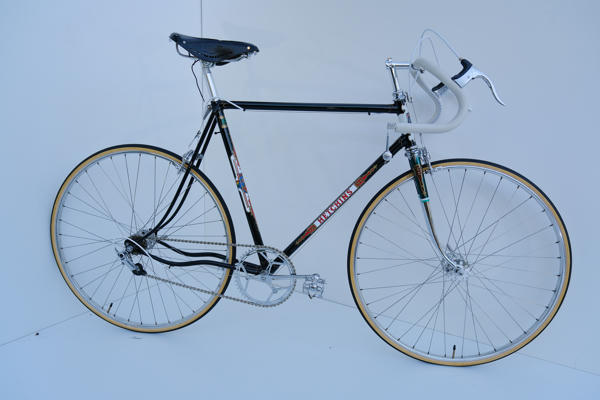
Hetchins Vade Mecum — The Curly-Stay Touring Companion
The Hetchins Vade Mecum — the name is Latin for "Go with Me" — was the marque's dedicated long-distance touring and audax model, positioned alongside the racing Nulli Secundus and the sportive Magnum Opus in Hetchins' characteristically Latinate model hierarchy. Produced from the 1950s through the 1960s at the Tottenham, North London workshop under the supervision of master framebuilder Jack Denny, the Vade Mecum translated Hetchins' renowned decorative artistry into a practical, all-day machine built for laden comfort rather than racing competition.
Model Positioning
Within the Hetchins range, the Vade Mecum occupied a distinct niche. The Magnum Opus was the all-round sportive and light-touring model; the Nulli Secundus was the thoroughbred racer; the Experto Crede the mid-range clubman's mount. The Vade Mecum was the uncompromising touring specialist — built with mudguard eyes, rack bosses, generous clearances for wider tyres, and a relaxed geometry intended for ten-hour days in the saddle across Britain's undulating B-roads and the demanding routes of continental cycle-touring. It was the bicycle you chose to cross the Alps with panniers, not to sprint for the village sign.
Frame Construction and the Curly Stay
Like all Hetchins frames of the Denny era, the Vade Mecum was constructed from Reynolds 531 butted manganese-molybdenum steel tubing — the definitive British lightweight tubeset. The hallmark curly "vibrant" stays were present in their touring-appropriate form: the seat stays described their characteristic S-curve or spiral before meeting the Campagnolo or Hetchins-pattern dropouts, while chain stays received the restrained single-wave treatment. On the Vade Mecum, the curly stays served both functions — the visual trademark that identified the machine as a Hetchins at a hundred paces, and the engineered vertical compliance intended to absorb high-frequency road vibration over long distances.
The frame incorporated brazed-on mudguard eyes at the fork tips and rear dropouts, pump pegs along the top tube, and often carrier rack mounts at the seat cluster and dropout eyelets. Clearances were generous by the standards of the era — typically accommodating 27″ × 1¼″ tyres with full mudguards, or 700C × 32 mm in modern terms. The fork featured a slightly extended rake compared to Hetchins' racing models, contributing to the stable, self-correcting handling essential for a loaded touring machine.
Geometry
The Vade Mecum employed relaxed touring geometry distinct from the steeper angles of the Nulli Secundus:
- Seat tube angle: 71–72 degrees, placing the rider in a more upright, sustainable position
- Head tube angle: 71–72 degrees, yielding slower, more predictable steering
- Fork rake: 50–55 mm, contributing to stable straight-line tracking
- Chainstays: 435–445 mm — noticeably longer than racing models, providing heel clearance for panniers and improving weight distribution
- Bottom bracket height: Higher than racing models to maintain pedal clearance on uneven touring terrain
- Wheelbase: Approximately 1040–1070 mm, significantly longer than racing contemporaries
Lug Work and Finishing
The Vade Mecum received the same hand-carved decorative lugwork that distinguished all Hetchins production. Head lugs featured the elongated arrowhead or spear-point cut-outs, bevelled and polished, that were the Denny workshop's signature. The fastback seat cluster and ornate bottom bracket shell — typically Chater-Lea or Haden pattern with additional piercing — confirmed the frame's position as a fully hand-built Hetchins. Paintwork was typically restrained touring livery: deep greens, burgundies, or classic black with gold lug lining and the distinctive Hetchins script decals on down tube and seat tube.
Component Specification
A period-correct Vade Mecum would feature components selected for reliability and serviceability over outright performance: GB or Cinelli alloy handlebars and stem, Brooks leather saddle (typically a B17 or B17 Narrow), Stronglight or TA crankset with low touring gearing, Huret or Simplex derailleurs for wide-range shifting, Mafac or GB centre-pull brakes for adequate stopping power with loaded panniers, Normandy or Maillard hubs laced to Rigida or Weinmann alloy rims, and full Bluemels cellulose mudguards.
Rarity and Collectability
The Vade Mecum is among the rarest surviving Hetchins models. Touring bicycles, ridden hard and exposed to weather, salts, and the accumulated abuse of continental crossings, survived in far fewer numbers than pampered racing machines. An original Vade Mecum with intact curly stays, period mudguard eyes, and authentic Denny-era lugwork represents a genuinely scarce find — the most practical expression of Hetchins' curly-stay philosophy, built for the open road.
Tags: Hetchins Vade Mecum, Hetchins touring bicycle, curly stay touring bike, Reynolds 531 touring frame, Jack Denny framebuilder, Hetchins vibrant stays, British lightweight touring bicycle, vintage audax bicycle, Chater-Lea bottom bracket, Hetchins fastback seat cluster, hand-carved lugs, Tottenham framebuilder, 1950s British touring bike, restored Hetchins, classic cycle-touring, Brooks B17, Stronglight 49D, Mafac brakes, Carradice saddlebag, Bluemels mudguards