Sport
Brand
BianchiDescription
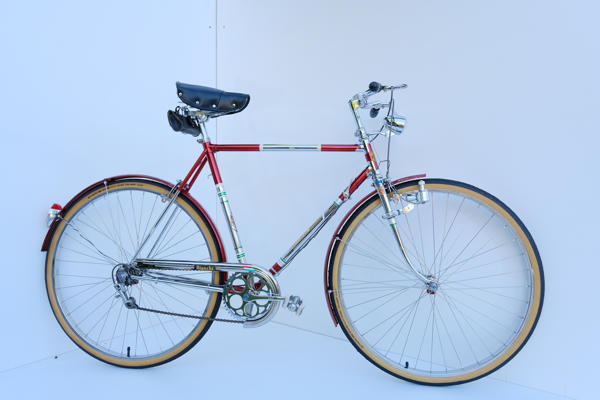
Bianchi Sport Condorino — The Accessible Celeste
The Bianchi Sport Condorino occupied the entry-to-mid range of Bianchi's post-war model hierarchy, produced from the 1950s through the 1960s and aimed at the sportive club rider, the touring enthusiast, and the practical cyclist who wanted a genuine Bianchi without the racing premium. The name Condorino — a diminutive of "Condor," one of Bianchi's long-running sportive model lines — suggested an accessible, slightly simplified version of its larger sibling: a bicycle that retained the essential Bianchi character in a more attainable package.
Model Positioning
Bianchi's post-war range ascended from utilitarian city bicycles through sportive-touring models like the Condorino, upward to the Campione del Mondo and Folgore, and ultimately to the Specialissima at its Reparto Corse summit. The Sport Condorino sat near the base of the performance hierarchy but well above the purely functional transportation models. It was the bicycle for the rider who valued the Bianchi name and the marque's signature celeste finish, but whose riding — club runs, weekend touring, daily transport — did not demand the lightweight tubesets and racing geometry of the professional-grade machines.
Frame Construction
The Sport Condorino employed straight-gauge carbon-steel tubing of Bianchi's own specification, or, on slightly higher-specification examples, Falck seamed tubing — the Milanese steelmaker's entry-to-mid-grade tubeset. This was not exotic material: the frame prioritised durability and comfort over the weight reduction of Columbus SL or butted Reynolds. Nevertheless, the fundamental construction quality reflected Bianchi's manufacturing standards — hand-brazed throughout with brass filler, clean shorelines, and the geometric consistency expected of Italy's oldest bicycle manufacturer.
Lugs were simple investment-cast or pressed patterns, unadorned with decorative carving but neatly finished. The fork employed a Bianchi-pattern crown — a simplified version of the sculpted design found on higher-tier models — with chromed fork tips. Dropouts were typically stamped steel with an integral derailleur hanger, often with mudguard eyes. Frames were built for Italian-standard threading.
Geometry
The Condorino employed relaxed sportive-touring geometry distinct from Bianchi's racing models: approximately 72-degree seat tube, 71–72-degree head tube, generous fork rake in the 50–55 mm range, longer chainstays (430–440 mm), and a wheelbase exceeding one metre. These proportions produced stable, comfortable handling suited to mixed surfaces, light loads, and the unhurried pace of the touring club rider — a bicycle that encouraged looking at the scenery rather than the stem-mounted stopwatch.
Paint and Finishing
The defining visual element of the Sport Condorino was its Bianchi celeste finish — the same blue-green hue that adorned the Specialissima, applied as baked enamel, and carrying the same immediate brand recognition. The frame featured the Bianchi head badge (often a metal plaque), the classic Bianchi script decal on the down tube, and the "Sport" or "Condorino" model designation on the top tube. Chrome was generally limited to the fork tips and sometimes the headset stack. The overall aesthetic was simple, clean, and unmistakably Bianchi — the colour doing the talking.
Component Specification
A representative Sport Condorino would feature modest but functional components: steel or alloy bars and stem, a Brooks or Lycett saddle, a steel-chained cottered crankset, Simplex or Huret derailleurs, Universal or GB side-pull brakes, and steel-barrelled hubs laced to steel or alloy rims. Mudguards were a common fitment, reflecting the model's practical, all-weather orientation. This was not a lightweight racing specification — it was a specification built for reliability and easy maintenance.
Why a Restored Sport Condorino Appeals
The Sport Condorino offers the entry point into vintage Bianchi ownership in its most accessible form. It delivers the essential Bianchi experience — the celeste paint, the script decals, the Milanese heritage — without the premium commanded by a Campione or Specialissima. The relaxed geometry and generous clearances make it a practical and comfortable rider for leisure and light touring. A sympathetically restored Condorino, built with period-appropriate components and finished in authentic celeste, is an honest, charming, and historically genuine Italian bicycle — the Bianchi for everyone.
Tags: Bianchi Sport Condorino, Bianchi Condorino, celeste Bianchi, Falck tubing, Italian sportive bicycle, Milanese bicycle, Bianchi script decal, 1950s Bianchi, 1960s Bianchi, vintage Italian light touring, hand-brazed frame, restored Bianchi, classic Italian bicycle, entry-level Bianchi