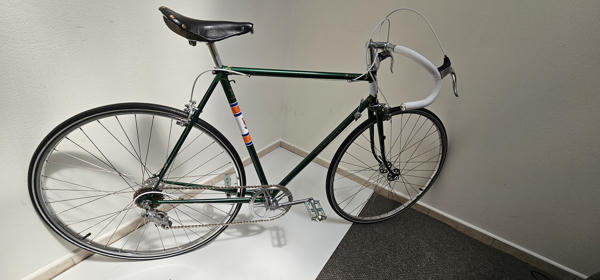
Monsoon
Brand
HoldsworthDescription
Holdsworth Monsoon — The Putney Touring and Winter-Training Specialist
The Holdsworth Monsoon, produced from the mid-1960s through the 1970s at the Putney workshop, was the marque's dedicated touring and winter-training model — a bicycle built for distance, durability, and all-weather dependability rather than racing competition. Following Holdsworth's meteorological naming convention, the Monsoon sat alongside the Professional (the race flagship), the Cyclone and Mistral (sportive all-rounders), and the Zephyr (the lightweight clubman's machine). Where its stablemates prioritised speed, the Monsoon prioritised steadfastness — the frame you chose when the destination mattered more than the average speed.
Model Philosophy
British club cycling of the post-war decades embraced a diverse calendar: racing in summer, reliability rides through spring and autumn, and — for the committed — youth hostel touring and winter training through the least hospitable months. The Monsoon addressed the latter half of that calendar explicitly. It was designed with generous mudguard clearances, brazed-on rack mounts, a stable geometry for laden riding, and the robust construction necessary to absorb thousands of miles of indifferent British road surfaces without complaint. The name itself — the seasonal wind that brings heavy rain to the subcontinent — was an unapologetic declaration of purpose: this was a bicycle built for weather.
Frame Construction
The Monsoon was constructed from Reynolds 531 plain-gauge manganese-molybdenum steel tubing or, on later examples, Reynolds 531 butted main tubes with heavier-gauge stays. The specification reflected the Monsoon's touring brief: plain-gauge 531, while marginally heavier than butted equivalents, offered excellent resistance to fatigue and the incidental stresses of laden riding — pannier loads transmitted through the rear triangle, the twisting forces of climbing out of the saddle with a saddlebag, the accumulated vibration of cobbled continental streets and potholed British B-roads.
The frame was hand-brazed throughout by the Putney workshop's roster of master craftsmen — Reg Collard, Charlie Roberts, and during the earlier period, frames likely bearing the influence of Bill Hurlow. Brazing was brass throughout, with the clean, even shorelines and full penetration that distinguished the shop's output from mass-produced alternatives. The Monsoon may have been a utilitarian model in Holdsworth's range, but it received the same fundamental build quality as the Professional: different tubes, same hands.
Frame Details
-
Fork crown: The distinctive Holdsworth-pattern full-sloping fork crown with elongated tangs, shared with the Professional and Cyclone, provided an instantly recognisable front-end identity. The fork blades were Reynolds 531 with a gentle taper and chromed tips.
-
Lugwork: Many Monsoons employed Nervex Professional pattern lugs (series 49/159) with heart-shaped cut-outs — the universal quality lug of the era — though with less extensive hand-filing than the Professional. Later examples used Bocama or Prugnat investment-cast lugs, clean in profile and appropriately finished.
-
Dropouts: Typically Campagnolo 1010 vertical on the rear, or Huret pattern on earlier models, with chromed faces and mudguard eyelets brazed to the underside.
-
Braze-ons: The Monsoon featured a comprehensive complement of practical fittings — mudguard eyes front and rear, rack mounts at the seat cluster and dropout eyelets, pump pegs on the top tube, and often a chainstay stop for a rear derailleur cable. A gear-cable braze-on beneath the bottom bracket shell was standard on later examples.
-
Cable routing: External along the top tube with brazed-on guides for the rear brake, and beneath the bottom bracket for derailleur cables — practical, serviceable, and consistent with the Monsoon's no-fuss ethos.
Geometry
The Monsoon's geometry was explicitly touring-oriented, sacrificing the quick responses of the Professional for the stability and comfort demanded by long-distance laden riding:
- Seat tube angle: 71–72 degrees — placing the rider in a more upright position conducive to hour after hour in the saddle
- Head tube angle: 71–72 degrees — yielding slower, more predictable steering that remained composed with front panniers
- Fork rake: 50–55 mm — generous rake producing stable straight-line tracking and reducing road shock
- Chainstay length: 435–445 mm — providing heel clearance for rear panniers and improving fore-aft weight distribution under load
- Bottom bracket height: 275–280 mm — sufficient clearance for pedalling through corners with wider touring tyres
- Wheelbase: Approximately 1040–1070 mm — the long footprint of a dedicated touring machine
The cumulative effect of these proportions was a ride quality defined by composure: the Monsoon tracked arrow-straight on descents, held its line through sweeping bends with a reassuring solidity, and absorbed road imperfections without transmitting harshness to the rider's hands and seat. It was not a bicycle for sprinting to the village sign; it was a bicycle for crossing counties.
Paint and Finishing
Monsoon finishes reflected the model's practical orientation. Standard colours included a deep Holdsworth blue, bronze-green, garnet red, and occasionally a champagne gold — all applied as baked enamel over anti-corrosion primer, with the Holdsworth script transfer on the down tube, the "Monsoon" model designation on the top tube, and the Reynolds 531 tubing transfer on the seat tube. Chrome plating was typically confined to the fork tips and rear dropout faces, though some examples featured fully chromed fork blades. The overall aesthetic was handsome and restrained — quality evident without ostentation.
Period-Correct Specification
A representative Monsoon would be built with components selected for reliability, weather resistance, and serviceability:
- Chainset: Stronglight 49D or TA Cyclotouriste with low touring gearing — a triple often specified for loaded Alpine touring, or a wide-range double (50/36 or 48/34) for British terrain
- Derailleurs: Huret, Simplex, or later Suntour — chosen for wide-range capacity rather than racing shift speed
- Brakes: Mafac or Weinmann centre-pull callipers — the standard choice for touring bicycles, offering ample power with generous pad clearance for mudguards
- Hubs: Normandy, Maillard, or Campagnolo Nuovo Tipo high-flange — laced 36 spokes to Rigida, Weinmann, or Mavic alloy rims
- Saddle: Brooks B17 leather — the unchallenged long-distance perch
- Bars and stem: GB or Cinelli alloy — comfortably wide bars with shallow drops for all-day positioning
- Pedals: Campagnolo or Lyotard platform pedals with toe clips and straps
- Mudguards: Bluemels cellulose or ESGE chromoplastic — full-length, essential equipment
- Luggage: Carradice cotton-duck saddlebag or full Karrimor rear panniers
Why a Restored Monsoon Appeals
The Monsoon occupies a distinctive position in the vintage Holdsworth hierarchy and the broader British touring bicycle market. Its appeal rests on several converging factors:
-
Purpose-built touring geometry: Unlike many vintage "touring" bicycles that are simply racing frames with mudguard eyes added as an afterthought, the Monsoon was designed from the outset for laden, long-distance riding — the relaxed angles, generous clearances, and stable wheelbase are integral, not adapted.
-
Putney provenance: Built by the same craftsmen who produced the celebrated Holdsworth Professional, a Monsoon carries the identical workshop DNA — identical brazing standards, identical quality control, identical attention to alignment — applied to a different riding purpose.
-
Practical usability: The generous clearances accommodate modern 700C × 32 mm or even 35 mm tyres, making the Monsoon not merely a period artefact but a genuinely capable touring bicycle for contemporary use on today's roads and cycle paths.
-
Relative accessibility: Touring models have historically commanded lower prices than racing equivalents, and the Monsoon — while increasingly sought after by knowledgeable collectors — remains more attainable than a Holdsworth Professional. This makes it an intelligent acquisition for the rider who intends to use the bicycle as well as admire it.
-
All-season character: The Monsoon's winter-training heritage — the capacity to run full mudguards, to accept a saddlebag, to shrug off poor weather and poor surfaces — distinguishes it from fair-weather garage queens. This is a bicycle with honest, unpretentious purpose.
A fully restored Holdsworth Monsoon, built with a period Stronglight or TA touring chainset, Mafac centre-pulls, Brooks B17, and a Carradice saddlebag, represents British cycle-touring at its most authentic — a machine from the Putney workshop's golden era, built to carry its rider reliably across Britain, Europe, and beyond.
Tags: Holdsworth Monsoon, Holdsworth touring bicycle, Reynolds 531 tourer, Putney framebuilder, Reg Collard, British lightweight touring, Nervex Professional lugs, Campagnolo 1010 dropouts, Stronglight 49D, TA Cyclotouriste, Mafac centre-pull brakes, Brooks B17, Carradice saddlebag, Bluemels mudguards, vintage British tourer, `w